The summer edition of the newsletter is now available on our website! Printed versions are in the mail, but you can grab a peek now.
As part of the summer newsletter, we have included two forms pertaining to our Holiday House Tour. First, we are once again planning to produce a program booklet to accompany the tour this year, and so we begin our request for sponsors. Sizes and rates are the same this year as in the past, and the PHW Office can provide more particulars if you are new to the booklet advertising opportunities. Click here for the sponsorship form.
Second, since we took a break from heavy volunteer usage in 2020, we have included a volunteer form as well. We are always in need of volunteers during the Holiday House Tour, and this time we’ve broken down the volunteer options a bit more so you can be paired up with a job you are comfortable with. Click here for the volunteer form.
Sponsorship and volunteer forms can be returned by email to phwinc.org@gmail.com or by snail mail to PHW, 530 Amherst St., Winchester, VA 22601.
Welcome to a new series of articles that will be posted once a month from now until June 2022. As the PHW Office will be closed for all business on a number of Fridays for the next year, we thought this would be a perfect opportunity to highlight some of our older collected work from our Kurtz Cultural Center era. To produce and compile this series, we will be utilizing a number of the major exhibits hosted in the KCC during the 1990s, including the titular “West of the Blue Ridge” and “James Wood & the Founding of Winchester,” with additional information from the Shenandoah University exhibit “Valley Pioneer Artists and Those Who Continue” (itself the starting point for much of the “West of the Blue Ridge” exhibit) and others.
The posts will draw from exhibit texts, student and teacher guides to the exhibits, the digitized exhibit images, printed materials, press releases, and even the playlist of music that accompanied the “West of the Blue Ridge” exhibit. We hope this series will be nostalgic if you experienced it the first time, and informative if this is your first brush with this part of Winchester’s history.
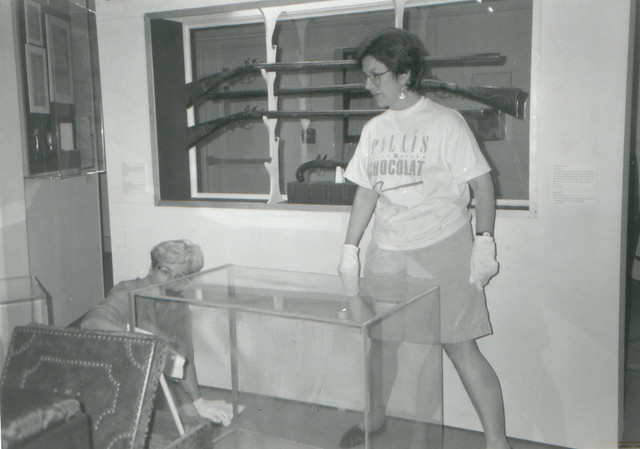
Workers ready displays for the “West of the Blue Ridge” exhibit at the Kurtz Cultural Center in 1993.
Believe it or not, Winchester, Virginia was once the “Williamsburg of the West.” In the late 18th and early 19th centuries, the lower Shenandoah Valley was a prosperous and bustling crossroads for western migration. The region was a gateway to the southern backcountry and the new western territories: across Valley roads moved people, goods, services, and ideas. Winchester, founded in 1744, was already the largest and most significant city west of the Blue Ridge after the American Revolution, when Americans were looking to the west of their new nation.
The series’ name “West of the Blue Ridge” derives from a petition in which area residents asked the state legislature to build a courthouse in Winchester because they were tired of traveling east of the Blue Ridge. In the petition, local people emphasized that they were different from people east of the Blue Ridge. About 40 percent of the population at the time was non-English, and the settlers kept many of their traditions alive, including through their decorative arts.
Whether on a large plantation or a small farm in Old Frederick County, agriculture formed the daily lives of Valley residents. By the American Revolution greater and more specialized crop production had combined with increasingly diverse manufacturing to form a sophisticated local economy. As part of this commercial expansion, Winchester became a thriving city that enticed merchants, craftsmen, physicians, attorneys, and their families to settle there. Winchester flourished at the crossroads of transportation routes west and south, becoming the largest city west of the Blue Ridge. We’ll explore more of the town growth in next month’s installment on September 17!
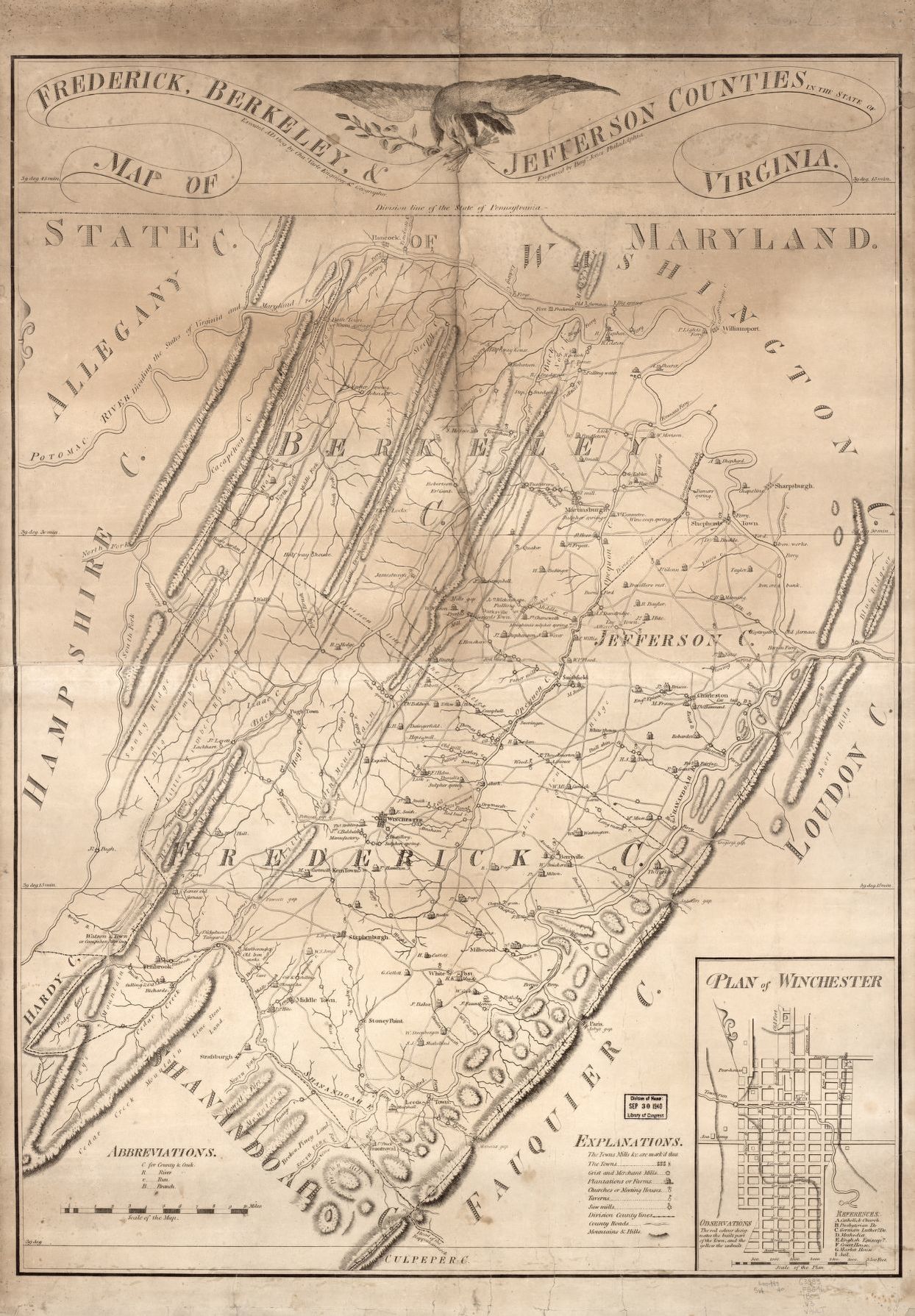
Varle, C. & Jones, B. (1809) Map of Frederick, Berkeley, & Jefferson counties in the state of Virginia. [Philadelphia: s.n] [Map] Retrieved from the Library of Congress, https://www.loc.gov/item/2008621756/.
“As this town is standing on the main roads to Pittsburg, Wheelen, Kentucky, Tennessee and the Warm and other springs, many strangers pass through it, which, besides the great intercourse it occasions, gives a gaity [sic] to the place, and has a great influence on the inhabitants.” – Charles Varle, 1809
Do you have an image of 426 N. Loudoun (unpainted brick, left) with a porch in place? Please share with us!
First, we have a specific image request to aid a local building owner. Do you have images of 426 North Loudoun Street between 1920-1950? Sanborn maps indicate a porch was once installed on the house during this timeframe, but by the time PHW or the Archives obtained photos of it, the porch had been removed (pre-1976 survey). If you have any view of this building that includes the front porch so we can get an idea of its appearance, please contact us!
The National Trust for Historic Preservation announced this week that they will be offering pre-conference workshops in September and post-conference webinars in November to extend the educational experience of their yearly PastForward conference.
These skill building workshops are free and open to all, and compliments content in the conference program. Registration is free and required for participation, however registration for PastForward Online 2021 is not required.
Understanding Climate Change Tuesday, September 21 • 2:00-4:00 p.m. This workshop provides clarity of definitions and terminology, describes climate concepts and outlines various strategies to address the impacts of climate on heritage.
An Introduction to Preservation Law + Easements Tuesday, September 28 • 2:00-4:00 p.m. This session provides an introduction to the legal mechanisms used to protect historic resources, including constitutional issues related to governmental regulation of historic properties, preservation easements, as well as federal, state, and local historic preservation laws.
Amending National Register Nominations Tuesday, November 16 • 2:00-4:00 p.m. Learn how to amend existing National Register nominations to address untold stories and underrepresented communities.
We’ve been having some yard maintenance this week at the Hexagon House, including treatments for a yellow jacket swarm and tree work. Don’t be surprised if the lot is blocked a day in the near future for stump removal, but the bulk of the work is complete. Thanks to the hardworking folks at the MSV, we should be safe from stinging insects and overgrown and dying vegetation when enjoying our lovely outdoor setting.
https://flic.kr/p/2meT8ad
The new floating bridge at the wetlands portion of the trails is now open!
If you haven’t had a chance to walk the new extension of the Trails at the MSV, why not take a quick jaunt around the floating wetland bridge next time you’re at the Hexagon House? There is a lovely circle around the pond that lets you get close to the wildlife, and two delightful humpback bridges to descend from the street level at Amherst to the pond. Plus, it’s literally just across the street!
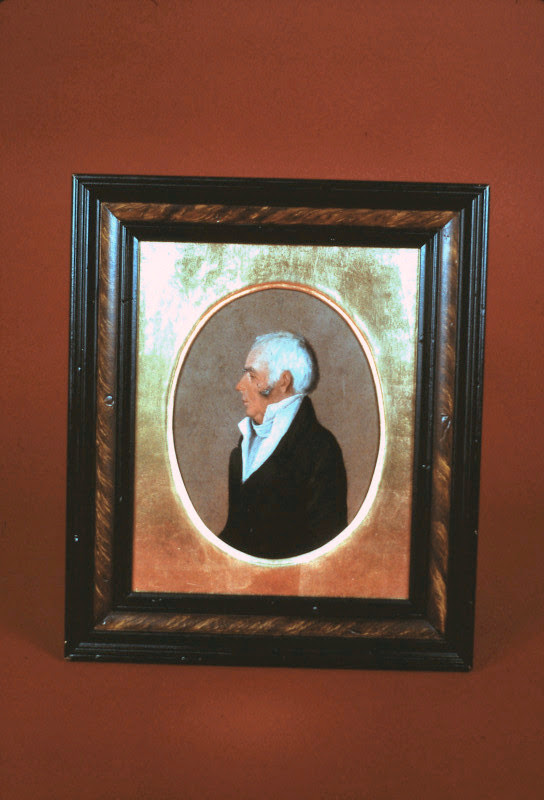
Slide of a portrait of Dr. Robert Mackey, exhibited in the Kurtz Cultural Center for “West of the Blue Ridge.”
While working on the daily image posts to social media and preparing a future blog post series, we had a confluence of research topics involving National Avenue and the tale of Lord Fairfax’s boots. Part of our behind the scenes work right now is going into identifying images from Kurtz Cultural Center exhibits. It has been a hit or miss prospect, as most of the slides are not labeled with the object name or source. This is somewhat mitigated by cross referencing the exhibit item lists and sources and then going back to the holding organization to confirm the identification guess.
While trying to determine if one of the digitized slide images was of James Wood, we incidentally spotted another portrait that also needed identification. The image turned out to be Dr. Robert Mackey (also often seen as Macky). The name had just recently been brought to mind after the recent trips to the post office to drop off some Limestone books to new owners. The trip usually requires passing by the George Washington’s Outlot marker on National Avenue. At the very end of the marker outside of the venerable brick Italianate house is the note the lot was purchased by the said Dr. Mackey in 1805. (Mackey, it seems, was doing some gardening on the outlot during its ownership by George Washington, so it seems natural he purchased the property in due time.) The timing was coincidental to also captioning a neighboring building on National Avenue and doing a bit of light file diving for more information on the area.
Mackey himself has been somewhat overlooked in the history books, perhaps because his descendant Frederick W. M. Holliday later became Governor of Virginia and thus overshadowed him. Most references are of the passing type, as seen here: “[Frederick W. M. Holliday’s] maternal great-grandfather Dr. Robert Mackey was a surgeon in the war of the Revolution, and at its close located at Winchester, took high rank as a man and a physician, and was the ancestor of several prominent families, both here and in other parts of the State.” — Norris, History of the Lower Shenandoah Valley
Frederick Holliday was the last private owner of the boots said to have been worn by Lord Fairfax. While the local tradition is sketchy, allegedly Lord Fairfax traveled to Winchester to consult Dr. Cornelius Baldwin in his final hours on December 9, 1781. Upon passing away, the boots were left in Dr. Baldwin’s hall or given to him as a sign of affection and esteem. The more likely story, as recently documented in Virginia Baron: The Story of Thomas, 6th Lord Fairfax, is that Dr. Mackey purchased the boots from the estate of Colonel Martin (believed to be the actual physician attending Lord Fairfax) in 1798. Mackey’s daughter Kitty married into the Baldwin family to explain the Baldwin connection to the tale. The boots subsequently passed through the Mackey descendants until they came into Holliday’s possession.
Until recently, the boots were unavailable for general viewing and seemed a bit like something out of a myth or existing just in dusty item catalogs (on par with the Sash of General Braddock). The confluence of names, locations, and images prompted another look to see if they had been added in the year or two since the last search, and finally, you may see these fabled boots entrusted to the Virginia Historical Society in their online collections.
Winchester is the recipient of a $25,000 Virginia Main Street Grant for a comprehensive revitalization project of East Piccadilly Street between the George Washington Hotel and the pedestrian mall. The project is stated to encompass 12 façade improvements, 16 community-designed parklets, and a large exterior mural. This stretch of Piccadilly has been one of our highlights in the daily image caption project on social media due to the business history contained in this block. We’re looking forward to seeing these predominantly late 1800s commercial buildings get the same love and attention as their neighbors on the Loudoun Street Mall.
https://flic.kr/p/mZZsj1
We were delighted to be gifted a few more prints of the first John Kerr School by Christy Broy at the MSV. One mounted on matboard was in PHW’s collection, and we had no idea any more existed. The suspicion is the prints of Bob Woods’ 1975 drawing were made as part of PHW’s efforts to preserve the school in the late 1970s. They were likely in the MSV holdings because Lee Taylor and/or Julian Glass were using them for PHW projects. (If you know any more details about how these prints came to be, let us know!) We anticipate having them available for purchase later, possibly at the Bough and Dough Shop or through some other venue. In the meantime, you can revisit the history of PHW’s involvement with the old John Kerr School with our Lunch and Learn Lecture “Partners in Preservation: Shenandoah University and PHW.”
Our Friday post this week ended up with a surprise feline in each section. See if you can spot them all! 🐈
We need paper bags of all sizes for the Bough & Dough Shop! All donations welcome, and any bags that are too damaged to use will be recycled.
This week, we took inventory of our Bough & Dough Shop supplies for the upcoming year. We request your assistance in donating gently-used paper bags of all sizes. We will be putting a receptacle on our back porch at the Hexagon House where you can drop off bags if no one is available at the office. Thank you for helping us keep our expenses low by using recycled and donated materials!
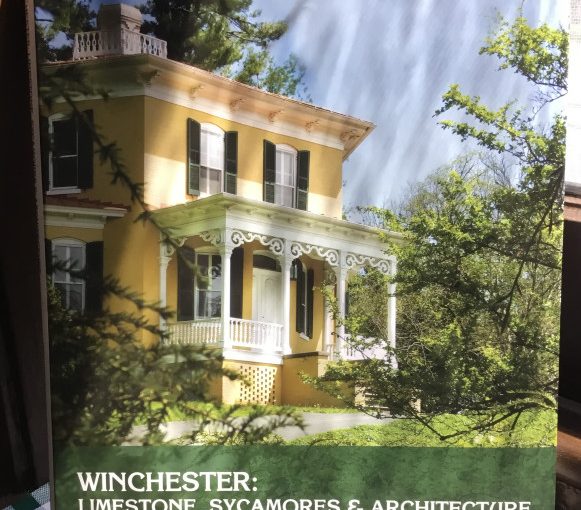
PHW is pleased to continue to offer a copy of the reprinted Winchester: Limestone, Sycamores & Architecture book with new memberships or renewals this year. We plan to send the next wave of snail-mail membership reminders out in early August, but you can renew online anytime through our website with a credit card, or download a membership form to mail in a check. Thank you for your support!
Some of you may be familiar with the unofficial PHW cat brigade and the health tribulations of the elder statesman, Severus. After a rough year through 2019 and 2020 with weight loss, high blood sugar, and other complications, he received a clean bill of health from his bloodwork this week. We hope we’ll be able to enjoy his grumpy and hissy (and occasionally greasy, like his namesake) antics for many more years.
We will be virtually attending the second “Dismantle Preservation” online conference next week between our normal office routines. Last year’s recordings are available online, and if you’re intrigued by any topics in this year’s event, you can join the conference through their website. In lieu of registration, the organizer recommends a $10/day donation or to support highlighted organizations through social media or email newsletters. (We admit we were suckered in by the “Cats and Brutalism” talk scheduled for July 28, 4:00-4:30 PM, but there are also more traditional topics.)
Similarly, the PastForward conference is now open for registration. The National Trust for Historic Preservation’s conference will be online again this year November 2-5. The conference subthemes include Promoting Equity and Justice Through Historic Preservation, Sharpening Essential Practices of Preservation, and Adapting to a Changing Climate.
You’ll never guess how someone found this image on Flickr…
Although Flickr does not provide stats for our entire viewing history, it looks like we may have broken our previous record for number of image views in a 24-hour period. We had over 29,000 views, primarily of the Millbank property album, on July 13. Our overall most-viewed image on Flickr is still the 1974 image of the Zayre store at 130 Delco Plaza, one of the long-forgotten collections unearthed from the basement of the Hexagon House (hence the unfortunate staining on the image.)
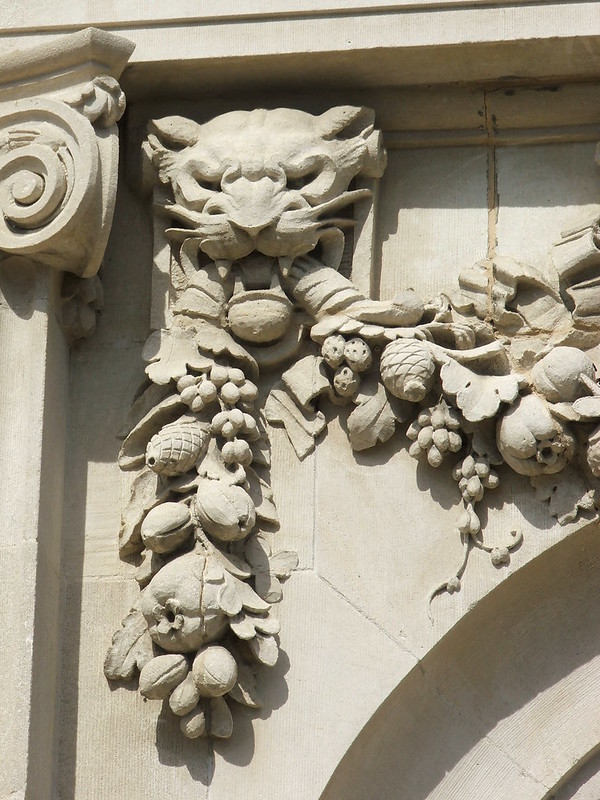
Since we began the caption project this January, we’ve seen more traffic on Flickr and more people finding our images with relevant, surprising and sometimes amusing text searches (our favorite this week is tiger nuts, the term used to find our feline festoon-holder on the Handley Library). We hope the images are proving informative and useful, and the increased captions are adding more depth and context. If there is an album, building, or photo in particular you would like us to focus our captioning efforts on, drop us a note on social media or at phwinc.org@gmail.com – we’re happy to take requests!
First, a public hearing on the proposed redevelopment at the corner of Cameron and Piccadilly streets Conditional Use Permit will take place on Tuesday, July 20, beginning at 3 PM in Council Chambers at Rouss City Hall. The CUP was triggered due to the size of the development exceeding by-rights use. If you are interested in making a statement on the project at the Planning Commission public hearing, you may review the submitted materials and staff report at the city meeting portal. PHW will note that according to the staff report, a previously approved demolition request and mitigation of the proposed loss of historic ghost signs on walls lining Baker Street has lapsed. PHW is in favor of retaining these ghost signs as they tell part of the story of the business enterprises in the area and the impact of the railroad on local commerce.
https://flic.kr/p/vp867T
Some of the ghost signs on the building lining Baker Street.
Second, tomorrow, Saturday July 17, is free admission to the MSV and a car show. The car show coordinated by the Shenandoah Region of the Antique Automobile Club of America will feature 60 vehicles at least 25 years old. Families are encouraged to stop by the picnic area next to the garden entrance to pick up a take-and-make car-themed craft and a brochure with a seek-and-find scavenger hunt activity for the gardens. Visitors may also enjoy free admission to several special exhibitions, including Norman Rockwell’s America and the MSV Invitational Outdoor Sculpture Show. The Roaming Bistro and Shaffer’s BBQ food trucks will be on site offering food and drink for purchase from 10 a.m. until 2 p.m. We’re excited to see this MSV tradition return this year!
Third, there is a call for proposals for the 2022 Main Street Now Conference. Proposals are due August 13 in three themed categories: Main Streets for the New Economy, Community Preservation and Expression, and Housing and Small-Scale Development. Visit the link for more information and how to submit proposals. Winchester was one of the three test programs for the Main Street Approach, and it may be time for us to show how our downtown is surviving and thriving forty years after the program launch.
We are pleased to inform you our quest last week to help a descendant find a copy of the Keith Williams print “Historic Buildings of Winchester” has borne fruit. Thank you to those who helped and shared stories related to Keith. By a confluence of events, we came across his resume as one of the applicants to the Kurtz Cultural Center RFP in the late 1980s. A select list of Keith Williams’ local projects include: the F&M Banks on Cameron Street and Valley Avenue; alterations and additions to First Christian Church and Opequon Presbyterian Church; renovation and organ installation at First Presbyterian Church; the Religious Education Building at First Baptist Church; the Winchester Church of Latter Day Saints; Robinson Memorial Elementary School and Gibson Elementary School buildings; Fremont Nursery School; the Child Day Care Center for Amalgamated Clothing Workers Health & Welfare Fund; Shenandoah University’s Armstrong Building, Howard Building, Funkhouser Building, Cooley Building, Racey Building, Student Center, Field House (1969), 100-Student Dorm (1972), and Library; showrooms for Molden Electric Company and Pifer Office Supply Company; offices and plant for Perry Engineering Company; Beltone Hearing Aid Center; factories for Monoflo International Inc. and Capitol Records; additions to Fulton Trucking Company and Burger King; the Golf & Country Club; the War Memorial Recreation Center; Country Club Pines Apartment Complex; Prospect Hills subdivision; tennis pavilion and club house complex at Lake Holiday Estates, The Summit; Winchester Seed Processing Plant; two Automatic Soft Cloth Car Washes in Winchester; and an acoustics consultant to John Handley High School renovation. We don’t quite recognize all the location names for his Winchester work and addresses and dates for most were not provided, so if you know any details about the above projects, let us know and we will compile them for our fledgling “architects of Winchester list” we’re developing at the office.
Save the date for the 2021 Holiday House Tour! Current plans are for the daylight tour only on Sunday, December 5, noon-4 PM. Plans and dates for the Bough & Dough Shop are not yet finalized, but we anticipate it will be held at the Hexagon House concurrent with the ticket sale window. All plans subject to change!
Preservation is in progress at the Thomas Phillips House, 124 W. Boscawen Street!
While scanning some posters from past PHW events for our digital files, we found some individual photographs from events still attached to display boards. While they may be duplicates, we erred on the side of safety and scanned them for our digital collection. You can catch those images, as well as a few others, at the top of our Flickr photostream.
Do you have a copy of the Keith Williams print of Historic Buildings of Winchester, 1969 (click here for a detail from the Stewart Bell Jr. Archives holdings to refresh your memory)? A descendant of is on the hunt for a copy. If you have one you are willing to part with, please contact the PHW office so we can put you in touch with the seeker.
The Clarke County Historical Association will be hosting Colonial Kids Day on Saturday, July 10 at the Burwell-Morgan Mill (15 Tannery Lane, Millwood, Virginia 22646) between 11 AM to 4 PM. The 5th annual event features interactive activities including blacksmithing, craft making, colonial games, a scavenger hunt, the history of the Mill, living history interpretations, and grinding in action. Buy tickets ($5 per person) in advance at Eventbrite or at the event itself.
The African American Heritage Preservation Foundation has created an app and website listing more than 1,600 sites throughout the United States and Territories that focus on the contributions of African Americans to our nation’s history. The app received an overhaul and relaunch in June 2021. Winchester’s Douglas School, through its listing on the National Register of Historic Places, is one of the featured Virginia sites, but we know that more could be highlighted here. If you have knowledge of other sites that could be featured on this app and site, get in touch with AAHPF to raise awareness and visibility for these places.
We were also alerted to a virtual event Afro-Virginia: Black Placekeeping and Power on July 22 at noon. Justin Reid, Director of Community Initiatives, Virginia Humanities and Manager, Virginia General Assembly African American Cultural Resources Task Force, will discuss Virginia’s contemporary Black cultural rights movement and his work promoting transdisciplinary, self-determined Black cultural placekeeping. Find out more and how to register for the free Zoom event at Brown University.
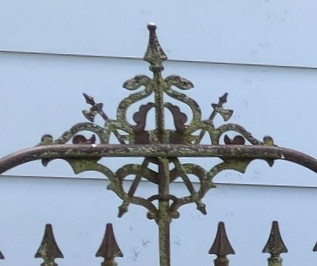
Detail of the fence with a distinctive gate ornamentation that provided the key to the manufacturer and thus its age.
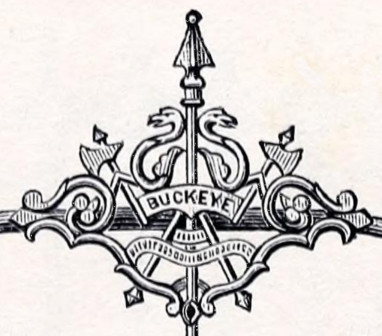
We had the pleasure to virtually visit the remnants of a wrought iron fence this week for some historical investigation. While it is a relatively small bit of fence, it fortunately retained the gate, which is one of the most likely places to find a manufacturer’s mark or other distinguishing maker characteristics. This gate was by far the most distinctive we have had the pleasure of examining, with an elaborate crest on the top with crossed halberds, heraldic sea snakes, and scroll-like decorative flourishes around the central finial. Although the label where the maker’s mark should be was not visible in the image, the gate design alone was unique enough that we could say with relative certainty it was a “Buckeye” wrought iron fence from the 1880s.
The catalogue image of the Buckeye gate ornamentation – exactly as advertised.
Naturally, having found such a distinctive architectural piece but never having heard of it before, it seemed like a good time for a little more investigation into the parent company. Buckeye fences were just one of the products produced by Mast, Foos & Company. Although founding dates have been contradictory, we are inclined to believe the company was founded in 1876 by Phineas P. Mast and John Foos in Springfield, Ohio, after Mast had undertaken earlier ventures in buggy and farm implements. In addition to the Buckeye fence, the company also produced wind engines, force pumps, lawn mowers, and lawn sprinklers. The company existed for almost 100 years after various acquisitions and remains well-known in Springfield, Ohio, particularly as Phineas P. Mast helped to found the local historical society. Read more about the Mast family and homes at Clark County History and explore a Mast, Foos & Company product catalogue at Archive.org.
Do you have an architectural research or identification question like this? Drop us a note and a photo at phwinc.org@gmail.com and we’ll see if we can help.
Did you purchase or were you gifted a copy of the reprinted Winchester: Limestone, Sycamores & Architecture book and found some pages were out of order? We were alerted that a copy given out at our Annual Meeting had this printing error. A quick perusal of our other open boxes has not turned up any more printing errors, but if you find one, we will be happy to swap out your printing error copy for one that is appropriately bound. Just let us know at phwinc.org@gmail.com or 540-667-3577.
While the PHW Office will be closed Monday, July 5 in belated celebration of the holiday, we have a fun historical tidbit from our archives to share for the holiday.
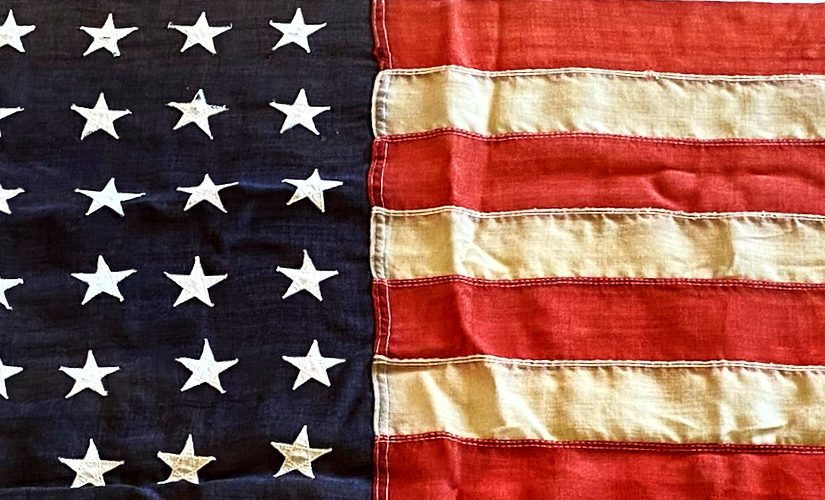
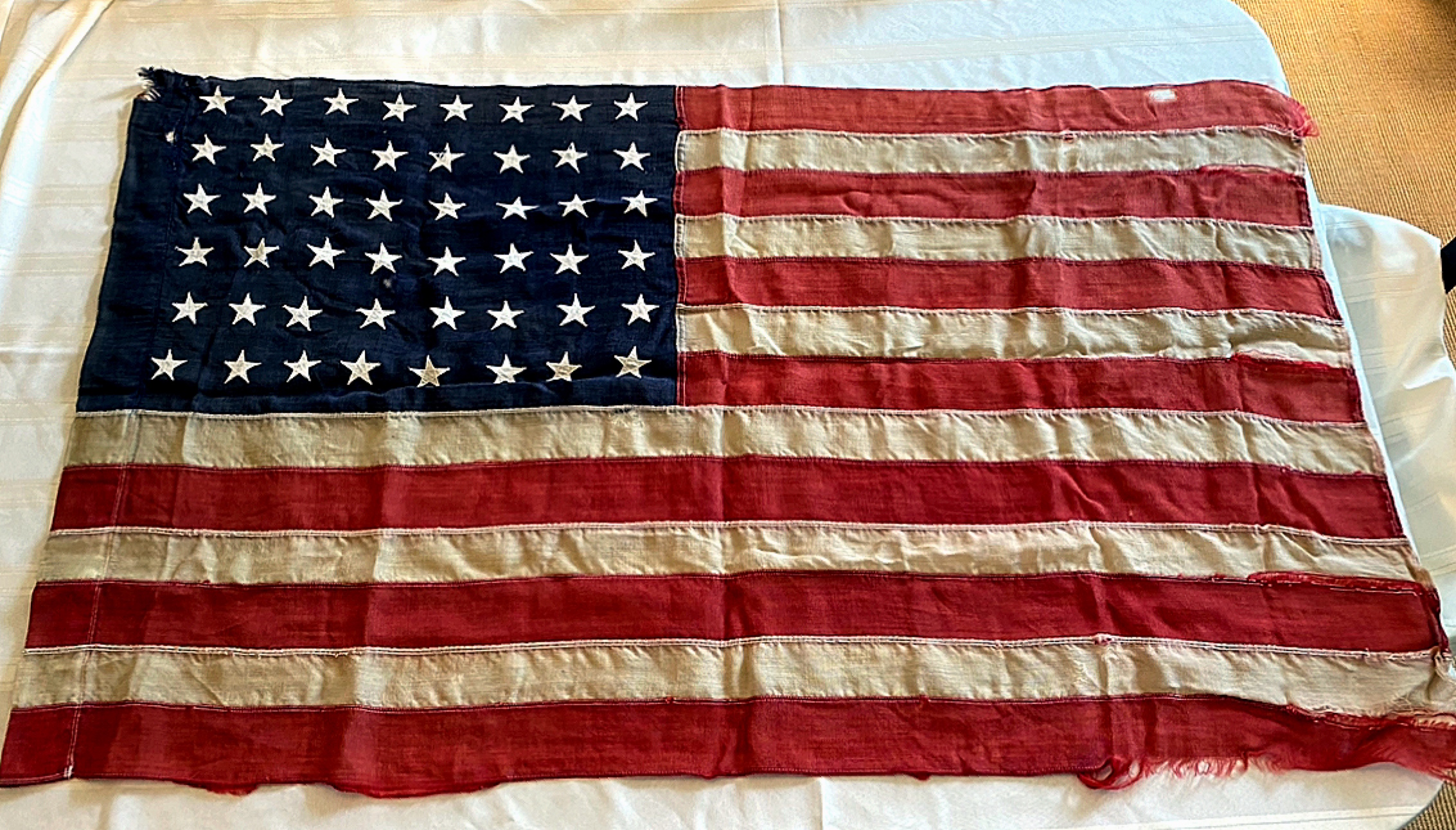
As you may have seen our current banner on social media, one of the artifacts entrusted to PHW is a flag of 48 stars donated by Gardner G. Phillips, Jr. The flag once hung in Pleasant Valley United Methodist Church on Cedar Grove Road. After a renovation of the church in the 1960s, coinciding with the retirement of the 48 star flag on July 4, 1959, this flag was given to the Phillips family of Clearbrook. In June 1993, the flag came into the possession of PHW through the Kurtz Cultural Center as a place where the flag, with its ties to a local church, could be held safely.
Although it does not appear the flag was ever used in a Kurtz display, it was kept safely in our small archival object holdings. It is clear the flag saw a great amount of use before coming to our organization, as it has begun to pull at the seams and a few areas where it was likely hung also show damage. This holiday provided the perfect excuse to do some regular archival maintenance to inspect the flag and refold it in a different manner to prevent damage and creasing.