It’s been a busy week at PHW, including our earlier announcement of our support of the Godfrey Miller Home and Fellowship Center’s exterior preservation and wrapping up our printing for the 2021 Holiday House Tour and Bough & Dough Shop. The printed items are beginning to arrive at PHW, so expect Holiday House Tour postcards to hit your mailboxes soon!
Our kitchen and library in the Hexagon House is undergoing its seasonal transformation into our Bough & Dough Shop, and some sale items have been trickling in, with more expected to arrive next week. Keep an eye on our Instagram for Shop updates and teasers when we get closer to opening day on Nov. 15!
We are so grateful for all the paper bag donations this year for the Shop. If you are feeling a bit more generous, PHW is also happy to accept packages of insulated cups with lids and hot chocolate, coffee, teabags, or cider mixes for the hot drink station during the tour. Thank you for continuing to support us with your in-kind donations to enrich the Holiday House Tour experience for everyone!
For a bit of Halloween fun mixed with an interior renovation, may we invite you to experience a Gothic-themed bathroom makeover this weekend? While the finished product might not be for you, it’s still an honest exploration of making a very tiny space reflect your aesthetic. (And when could we ever share a makeover project like this if not for Halloween?)
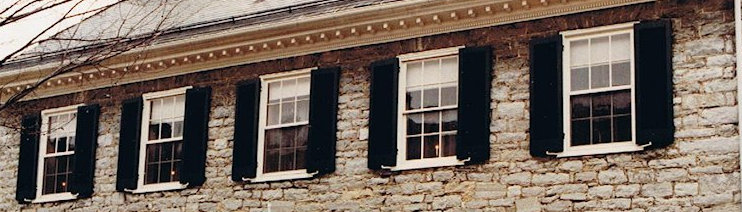
The Godfrey Miller Home and Fellowship Center dressed up for Holiday House Tour 1982. This iconic downtown facade needs your help…
PHW is thrilled to announce we have teamed up with the Godfrey Miller Home and Grace Evangelical Lutheran Church to help retain one of downtown’s iconic historical structures. Earlier this fall we visited the Godfrey Miller Home at 28 South Loudoun Street, at the heart of the Old Town Mall, for a site visit with the new executive director of the Fellowship Center, Jason Gottschalk.
The limestone building, constructed circa 1785, is in need of significant exterior maintenance for safety as well as aesthetic reasons. Repairs are needed primarily on the wooden exterior elements, including the roof rakes, lower roof panels, trim and moldings, 28 shutters, a rear dormer, the front porch, and the front door and transom. Some of the most significant work will be the repair and reglazing of 18 windows, as well as carefully removing lead paint to provide a clean working surface for the repair and repainting of the wooden elements.
The work will be performed by the Durable Restoration Company, which recently completed work on the Grace Evangelical Lutheran Church spire on West Boscawen Street. It is expected to cost about $109,000, a significant amount for anyone, and especially so for a nonprofit organization.
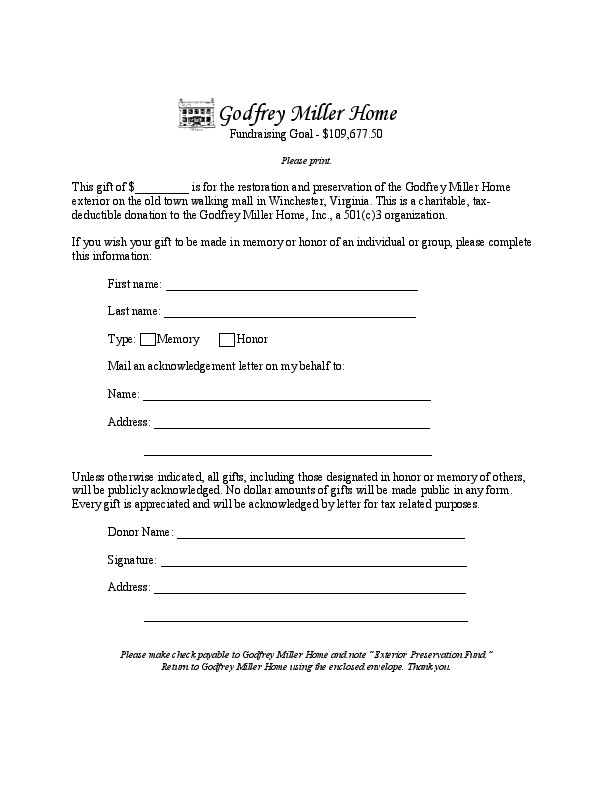
Seeing the need, oncoming commencement of the work, and our past successful partnerships with the Grace Evangelical Lutheran Church and the Godfrey Miller Home and Fellowship Center, the PHW Board of Directors voted to pledge $10,000 in support of the project. We also pledged to reach out to our membership and readers to ask you to join us, as you did for the Old Lutheran Church Wall project, to help match our pledge.
Make sure you slip over to the MSV Gardens soon before these crows and other outdoor sculptures fly away on October 31!
We seem to be drawing to the end of our interior yellow jacket swarm saga at the Hexagon House. Things that have been learned from this experience include:
Yellow jackets will burrow into your houseplants’ soil, cling to your radiators for warmth, find past holes in the interior woodwork, and settle in.
Closing off the room of entry from the rest of the house mostly contained the wasps to one room while pest control methods did their work.
In sufficient numbers, the swarm will set off the motion sensors in the alarm system.
Yellow jackets will leave behind excrement on your walls. Luckily, the excrement is reportedly nontoxic, and cleaned up easily enough with a bit of light scrubbing.
Dead yellow jackets in concentrated numbers have an overwhelming stink similar to dried fish food flakes.
Even though the yellow jackets were contained primarily to one room, the cleanup took longer than expected, even with multiple cleanups during each die-off wave. Leave yourself plenty of time and have a vacuum with a good crevice tool on hand to get all the bits and pieces.
We ask you to still exercise caution around the Hexagon House exterior, as the yellow jackets are still in the area around the front porch. They have been well-behaved outdoor neighbors, but we do not recommend long-term indoor cohabitation.
Thank you all for your patience while we waited to announce our 2021 Holiday House Tour lineup. We are easing our way back into the holiday tradition with three homes this year, 25 West Piccadilly Street, 321 South Stewart Street, and 814 South Washington Street. None of the buildings have been opened to the Holiday House Tour before, and we are excited to share them and their renovation stories with you this year. We are also looking forward to renewing our partnership with Winchester Little Theatre to provide costumed carolers during the tour, and free hot drinks will be served on Sunday at the Bough & Dough Shop at the Hexagon House.
The tour will be held on Sunday, December 5 between noon and 4 PM. We ask that visitors come prepared with face masks and be understanding that they may need to wait in line outside the homes (so dress for the weather and wear comfortable, low-heeled shoes). We expect the group sizes going through the homes may be more limited in the size this year than some other years, and please remember to keep up your social distancing while you wait.
Ticket prices are set at $20 per adult in advance, and $25 at the door. This year we will not be offering single-site admission tickets. Advance tickets will be available for purchase in person at Kimberly’s, Winchester Book Gallery, the Winchester-Frederick County Visitors Center, and the Bough & Dough Shop at the Hexagon House, as well as online and by mail. We plan to have tickets available for purchase starting November 15; the program booklets may be slightly delayed, but online versions will be made available by November 15.
Entrance panel to “West of the Blue Ridge” with scythe from Edward Durrell Collection, COSI, Ohio’s Center of Science and Industry and “Over the Blue Ridge” photograph by James N. Holmes.
In 1729-1730, Jacob Stover petitioned to create a 13th colony from the Virginia interior and bring Swiss-German farmers as settlers. This was a departure from the pattern of settlement in the east of Virginia, where grants were typically made to the wealthy English. The petition to the Colonial government struck at a fateful time. The Shenandoah Valley had been a place of escape for slaves fleeing a James River plantation in 1727. Although they were captured, the idea of the Valley becoming a haven for escapees had been planted in Virginia Governor William Gooch’s mind. This petition offered a way to settle the land and simultaneously not endanger the English elites.
Gooch denied the petition for the new colony, but approved immigrant farmers settling the Valley. The grants were to be made to “persons of low degree in life who are known amongst their equals as morally honest.” The stipulation was to have one family for every 1,000 acres. Attracted by the prospects of inexpensive and rich farmland, successive waves of Scotch-Irish and German immigrants settled in the valley.
“The necessary labors of the farms along the frontiers were performed with every danger and difficulty imaginable. The whole population of the frontiers, huddled together in their little forts, left the country with every appearance of a deserted region; and such would have been the opinion of a traveler concerning it, if he had not seen here and there some small fields of corn or other grain in a growing state.” — Samuel Kercheval, 1850
Various farm implements were displayed, including a 19th century grain flail from Jefferson County Museum, Charlestown, West Virginia; a cowbell and a cow hobble from the Edward Durrell Collection, COSI, Ohio’s Center of Science and Industry; and an early 1800s sleigh from a local collector.
At first farmers in Old Frederick County raised crops and animals mostly for their own subsistence, but the rich soil and moderate climate combined to make the Valley the most important wheat-producing region in the Upper South by 1800. The change to wheat as a primary cash crop instead of tobacco as in eastern Virginia was said by Samuel Kercheval to have been inspired by the French Revolution in 1794, when all kinds of bread stuffs became enormously expensive. Wheat and flour production enriched the region for years afterward. In addition to wheat, local farms produced rye, oats, corn, and hay said to be “superior in quality and quantity” than average.
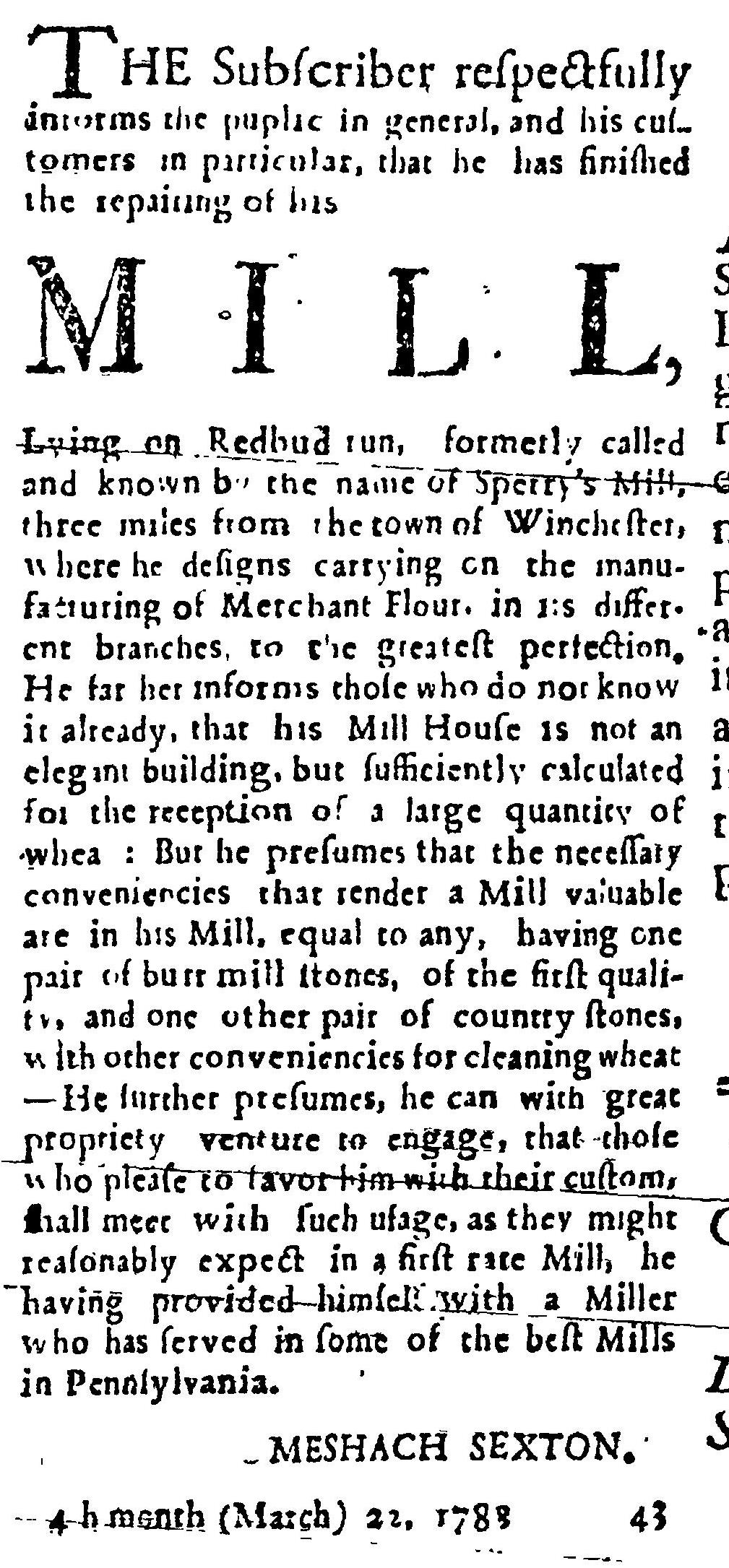
Advertisement publicizing the repair of Sperry’s Mill on Redbud Run, said “not to be an elegant building, but sufficiently calculated for the reception of a large quantity of wheat.” – Winchester Advertiser, May 7, 1788
By the American Revolution the average Valley resident owned between 100 and 400 acres: increasingly, however, larger tracts of land were concentrated in the hands of a select few and tenancy was on the rise. To the west of the Opequon Creek, small family farms characterized the landscape: few people held more than 100 acres. On these small farms, families worked together in the fields. Samuel Kercheval remembered, “Many females were most expert mowers and reapers.” The yoke displayed from the Edward Durrell Collection, COSI, Ohio’s Center of Science and Industry, is the size worn by a woman or a child.
By contrast, the eastern Virginians who settled in east Frederick County in the 1780s and 1790s recreated Tidewater plantation society. These farms were set up with grand manor houses and large-scale agricultural production. Larger farms like Vaucluse outside of Stephens City could also have mills for flour production on site. Foreseeing the growth in agriculture, in 1785 Nathaniel Burwell and his partner, Daniel Morgan, established a merchant mill to buy, sell, and mill local grain and export flour in Millwood. Along with the positives of a successful commercial crop on the local economy, wheat and the large-scale agricultural endeavors helped spread slavery in the Valley. By 1800 approximately 5,000 enslaved African-Americans lived in Old Frederick County, a little more than 32% of the population.
Slavery as an institution was not universally embraced by the Valley settlers. In 1782, Virginia law made the private manumission of enslaved individuals permissible. In an attempt to further this work, a group of Frederick County residents petitioned the Legislature in 1785 to outlaw slavery. Although unsuccessful in this early abolitionist attempt, Winchester became a haven for free African-Americans. Free African-Americans were required by law to register in their place of residence and to carry on their person at all times written proof of their status. Dennis Johnston was among the twenty-one Frederick County slaves manumitted by planter Robert Carter in 1799 and issued a certificate of freedom. His name, along with many other locally-recognizable names, appears in the Winchester 1833 Free Negroes and Mulattoes list available at the Library of Virginia.
Join us next time on November 19 to examine the commerce west of the Blue Ridge!
The French and Indian War Foundation and Winchester Public Schools invite you to a lecture “Handley High School: The Jeffersonian Soul of Winchester” by Dr. Carl J. Ekberg on October 24, 2 PM, in the Patsy Cline Auditorium at Handley High School. The event is free and open to the public.
Would you like a fact sheet to help guide you through the HTC-GO bill mentioned in the last Friday Roundup post? Check out the National’s Trust’s fact sheet to help you understand why this update is a potential boon to nonprofits working with historic buildings.
From the National Trust Forum is a notice of the 2021 Pennsylvania Hallowed Grounds Annual Meeting “Reclaiming African-American Cemeteries in your Community.” The event will be held Saturday October 23, 2021 virtually from 10 AM – 3 PM. All who are interested in cemetery conservation are invited to attend the meeting at no cost. However, to join the meeting online you must register in advance. To register go to Eventbrite or the Facebook for PAHallowedGrounds.
For a bit of levity familiar to old house enthusiasts and timely to the season, check out the “My House in October” comic by Brian Gordon at Fowl Language Comics. We approve of fixing up your scary facade when the weather permits, though! For just such a story, stop by WMRA’s coverage of the Bath County Pools Restoration Is Back On…Again to check in on this Endangered Property highlighted by Preservation Virginia in 2010.
https://flic.kr/p/2my3zie
Work on the side porch is progressing at 124 W. Boscawen Street. Take a peek next time you pass by!
Thanks for your patience as we hold the announcement of the house line up for the Holiday House Tour. We can confirm tickets will be available for purchase starting November 15 at the Bough & Dough Shop at the Hexagon House, Kimberly’s, Winchester Book Gallery, and the Winchester-Frederick County Visitors Center. An online purchase option will also be available, along with a digital version of the program booklet.
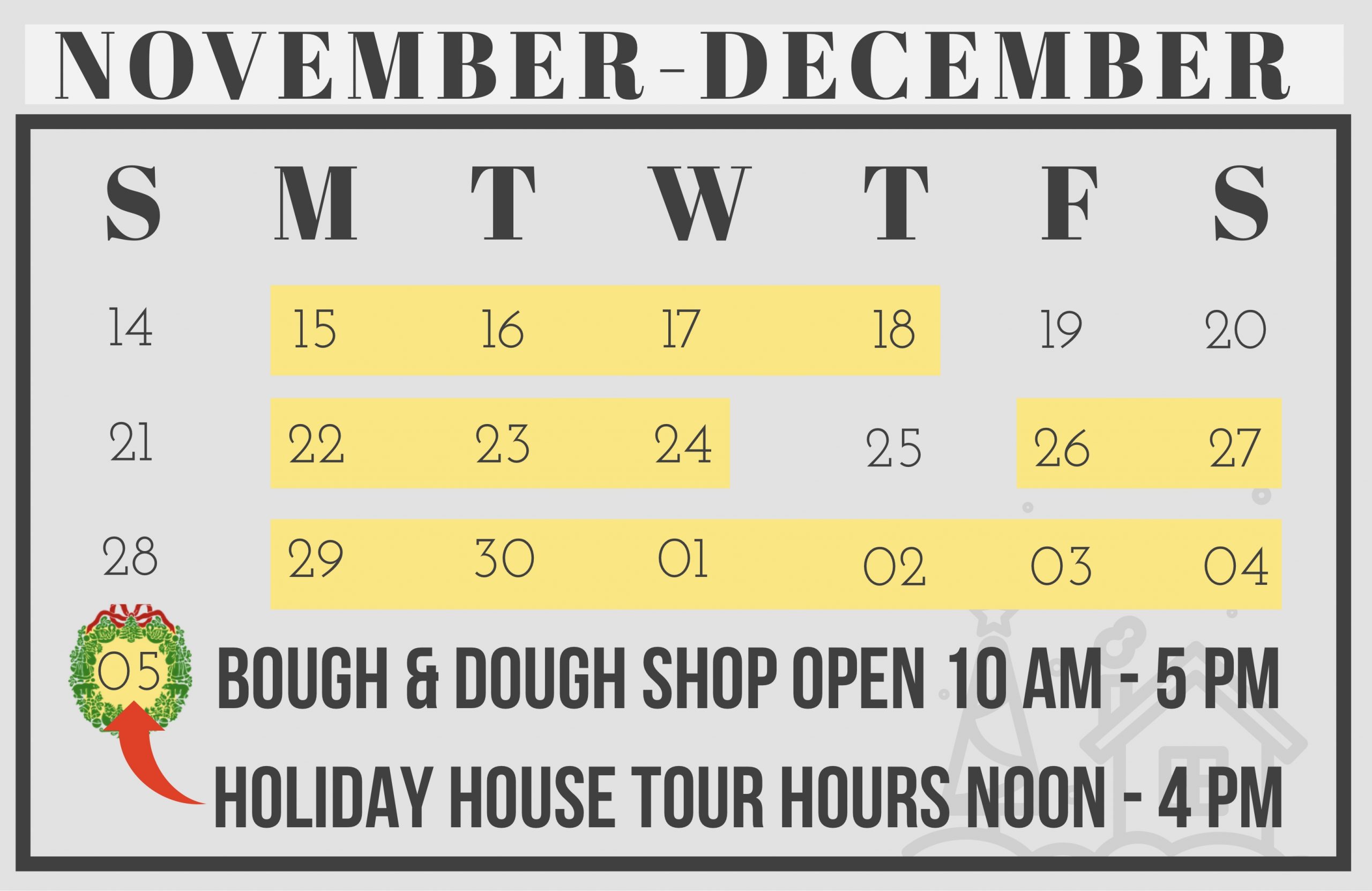
To tide you over until we have more updates on the tour side, we’ve prepared a visual guide for our Bough and Dough Shop. The schedule for 2021 is going to be a little different than our past years’, so to help you plan what days the shop will be open, we have created a calendar below. Be sure to visit the Hexagon House on the days highlighted in yellow to do some local shopping between 10 AM and 5 PM. Please note we are reducing the shop floor space to just the kitchen and the greenery on the back porch this year.
We will most likely be in need of evergreen cuttings for the “bough” side of the shop. If you have plans to trim or remove cedar, pine, juniper, boxwood, magnolia, holly, or other greenery in late November, we will be grateful to accept your clippings at the Hexagon House during the Shop. We recommend making large drop offs prior to 10 AM, after 5 PM, or on our closed days to prevent congestion in the parking lot with shoppers. Volunteers may be able to trim and haul smaller plants for you. If you have questions about greenery donations, please contact us at phwinc.org@gmail.com or 540-667-3577.
PreserveCast has an interview up with Merrill Hoopengardner to talk about the historic tax credit. From the podcast description: “In mid-September, House Democratic-led committees approved a more detailed $3.5 trillion package of bills with HTC enhancements similar to the HTC-GO (H.R. 2294). Next in the legislative process, the bill must move to the House floor, pass the House, pass the Senate, and be signed into law. Washington insiders believe that a final bill will be negotiated with the Senate before it goes to the House floor and is likely to be significantly reduced in both size and scope. If passed, the infrastructure bill would include the most substantial enhancements to the Historic Tax Credit in a generation. To support the efforts in getting these provisions across the finish line, please reach out to all Democratic Senators and ask them to support the HTC enhancement provisions included in the House infrastructure bill. To learn more about how you can contact your representative, click here.“
https://flic.kr/p/2mvZbFZ
Deer visited the backyard at the Hexagon House this week.