Friday Roundup: The Elms

Sparked by the interest shown in The Elms Motor Court buildings along Valley Avenue, we have done some preliminary research to see what information is available about the motel. As a number of other online researchers have commented, finding historic information about the motel specifically is a bit hard to come by, so we wanted to make the information we gathered at PHW accessible as we continue our documentation of the site.
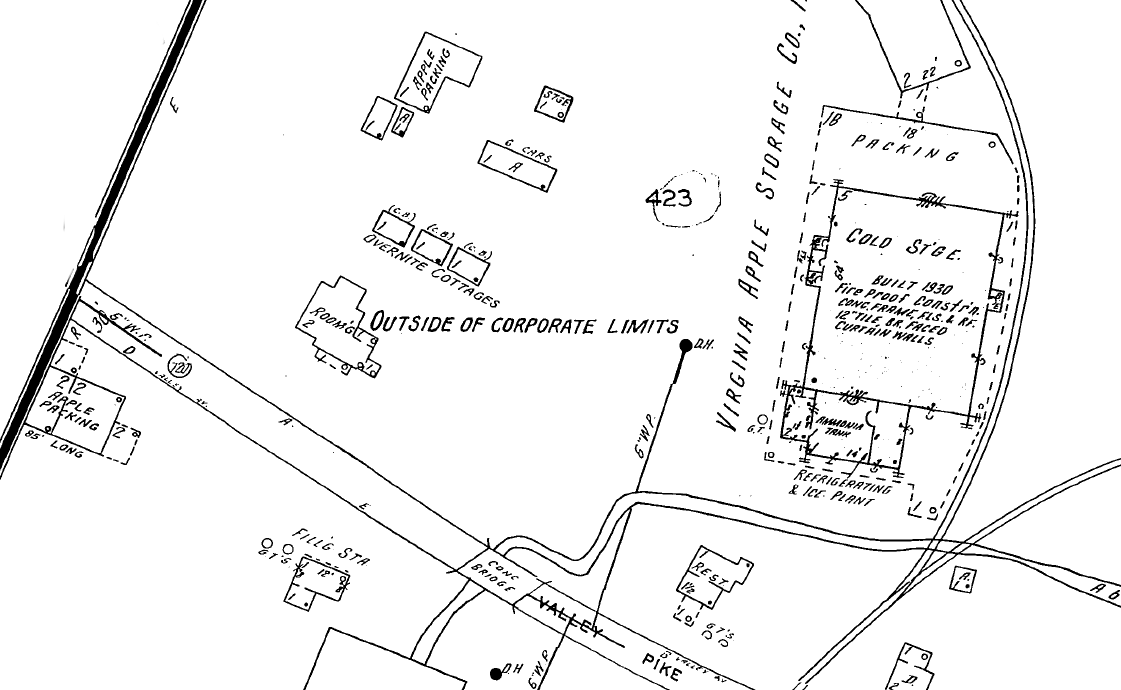
The 1947 Sanborn map documents The Elms, consisting at this time of the main house and three concrete block overnight cottages. This was the first time the map extended this far from downtown Winchester.

A Winchester Evening Star article dated Nov. 3, 1954 supplies most of our historic information for this post. L. Adolph Richards, the author, wrote several other articles on buildings on historic interest in the mid-1900s, and it appears he pulled most of his information from T. K. Cartmell’s writings, so we trust that the basic information provided was verified.

In this article, Richards notes the land was granted by Virginia Governor Gooch to Isaac Parkins in 1735. Isaac’s son, Nathan Parkins, built the home as well as a mill across the road. Nathan lived in the home until his death in 1830; subsequently it was occupied by T. T. Fauntleroy, George W. Hillyard, William Richards (who dubbed the house “The Elms”), and Mr. and Mrs. L. V. Watson. In April of 1954, the Chickla Brothers of Pittsburgh purchased the property and owned it during the heyday of the Elms Motor Court.
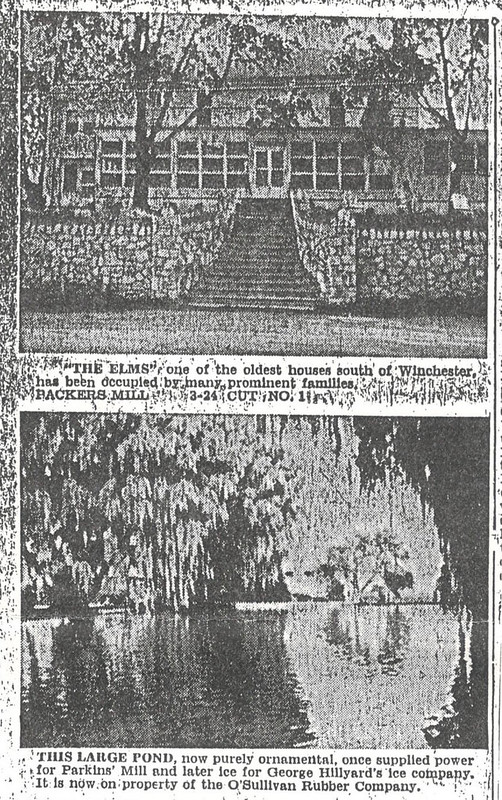
The Elms and Keckley Mill Pond
1954 newspaper images of The Elms and the pond across the street.

By the time of a 1963 aerial image viewable on Historic Aerials, The Elms had completed the construction of the additional cottages in an L shape around the house. The main stone house was used for room rentals, as well as a restaurant in its later life. The building, thought to be the oldest house on the south side of Winchester, was demolished in early 2010. The lot, including the elm trees, was leveled and grassed over and has been vacant since that time.

Keckley Mill
The Keckley Mill, ca. 1995 shortly before demolition.

The Parkins Mill, built along Abram’s Creek, was destroyed during the Civil War and was rebuilt by Jacob Keckley in 1872. At an unspecified point (perhaps around 1930), the mill was converted to apple packaging, as seen on the 1947 Sanborn map. The Keckley Mill has also been demolished. In a newspaper clipping from December 27, 1995 detailing the demolition by Cynthia Cather, it was last occupied by Shenandoah Appliance Co. for about 17 years prior to demolition. For those familiar with Winchester in the 1980s, it was well-known because of a stuffed gorilla placed outside the entrance to the building.

The rectangular pond across the road from The Elms was used as a dam to hold water from Abram’s Creek to turn the water wheel for the Parkins and Keckley Mill, as well as being used for ice by the Hillyards. We assume this article from 1931, printed below, is the pond where the perch were poisoned.

HALF-MILLION PERCH ARE KILLED IN POND

Game Warden F. M. Pingley reported that approximately 500,000 yellow perch had been killed in the past several days in a fresh water pond at the Elms, near Winchester, Va., which, it is claimed, was due to the pollution of Abrams Creek, which feeds the pond. Informed of the killing, Maj. A. Willis Robertson, of Richmond, State commissioner of game and inland fisheries, notified Warden Pingley to proceed to prosecute the agency believed guilty of polluting the stream and killing the fish. Game Warden Pingley procured a warrant from County Magistrate A. J. Tavenner against the Virginia Apple Storage Company, operating a large plant on Abrams Creek, charging the corporation with having polluted the stream by emptying a solution of lime from their plant into the stream. The warrant was served on L. Jackson, manager. —Chief Justice, Volume 4, Number 29, 21 July 1931

More images, primarily of the Keckley Mill, are now available at our Flickr. We anticipate adding more images of the Elms Motor Court buildings soon.
West of the Blue Ridge Series: Portraiture

The music for this installment is “The Butterfly.”

The text for this installment is adapted from “Fine Art and Fraktur” by Linda Crocker Simmons in the “Valley Pioneer Artists and Those Who Continue” exhibit catalog, with information from the “West of the Blue Ridge” exhibit. Most images of the portraits displayed at the “West of the Blue Ridge” exhibit are from digitized slides attributed to Elaine Rebman.

Kurtz Cultural Center Exhibits
Dr. Robert Macky (or Mackey) by an unknown artist, ca. 1800-1810. After serving as a surgeon in the American Revolution, Dr. Macky settled in Winchester. Winchester-Frederick County Historical Society.

The 1790s to the 1840s was a period of great flowering for American folk art. Previously represented solely by painters in New England, folk painters active in the South have now been identified. At the time of the “Valley Pioneers and Those Who Continue” exhibit, seventy-five painters who worked in the Lower Shenandoah Valley from 1780-1880 had been identified. Only twelve of those were native to the region: Eleazer H. Miller, Elliot Daingerfield, William Leigh, Alexander R. Boteler, Richard Norris Brooke, Edward Caledon Bruce, Innes Randolph, Johannes Spitler, Jacob Strickler, David Hunter Strother (“Porte Crayon”), William de Hartburn Washington, and Eliza Kern.

"West of the Blue Ridge" Exhibit
Oliver Funsten (or Funston) (1780? – 1826) by an unknown artist, ca. 1800, executed in watercolors on brown paper. Virginia Historical Society.

Painting in the United States in this period underwent dramatic developments and changes in styles. Although the Lower Valley was not a center for innovation, the painters active here often reflected the changes that had occurred in New York, Baltimore, Philadelphia, or Boston, albeit a few decades later. Patronage determined much of what an artist painted, and in the Valley the demand for portraits was constant, followed in lesser degrees by landscapes, still-lifes, and genre scenes of everyday life.

A diversity of media was usual throughout this hundred-year period. Miniatures were much more common than is recognized. In the decades before the 1840s when photography was introduced, they were the preferred form for small, easily transported portraits. It is likely that many more miniatures were created than are known or have survived. In addition to having a miniature portrait painted in watercolor on ivory, Valley sitters could also commission their portrait in chalk, watercolor, or ink on paper.

"West of the Blue Ridge" Exhibits
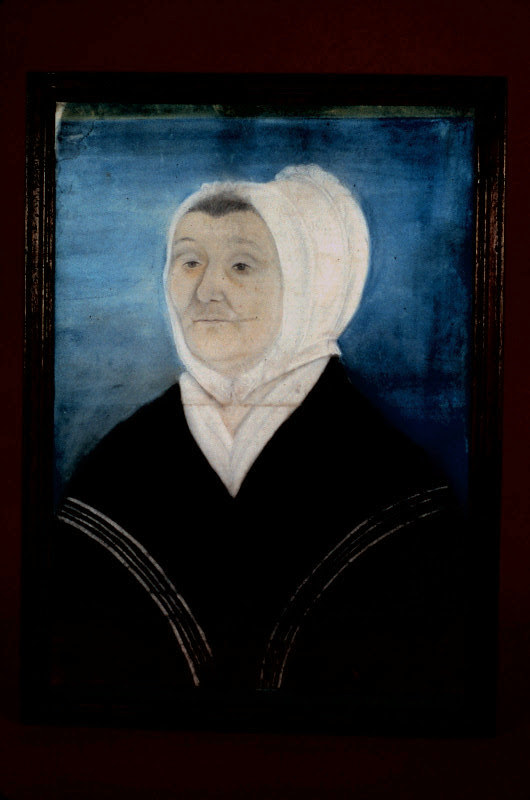
Anna Marie Kurtz Miller, attributed to Frederick Kemmelmeyer, ca. 1800. The portrait is executed in pastels, a relatively rare medium. Mrs. Miller emigrated to American with her family. She was married to Godfrey Miller, the stocking weaver and apothecary.

In the Valley, as elsewhere, one of the easiest methods of locating a painter was through newspaper advertisements. The two earliest names uncovered are William Dering and L. M. Christophe. Others discovered through similar searches are Charles Peale Polk, Joshua Johnson, Frederick Kemmelmeyer, John Drinker, and [William Joseph] Aldridge. This group was likely the most influential on painters in this region during the “golden age” of folk painting. A significant level of activity was sustained from the 1790s through the 1820s by these itinerants seeking portrait commissions in the Lower Shenandoah Valley.

Orphaned as a small child, Charles Peale Polk (1767 – 1822) was raised in Philadelphia by his uncle, Charles Peale, who taught him to paint. In 1791 Polk moved with his wife and children from Philadelphia to Baltimore where he worked as a portrait painter and merchant. He left in 1796 for Frederick Co., Maryland, then traveled from there as an itinerant painter through western Maryland and Virginia. After the election of Thomas Jefferson, Polk, a political supporter, moved to Washington DC where he received an appointment as clerk, a position he held for 16 years. In 1820 after his third marriage, the family moved to a farm in Richmond Co., Va. where they resided until Polk’s death in 1822.

Kurtz Cultural Center Exhibits
Necklace with miniature portraits of Margaret Strother Morton Jones (1726-1822) and her children, ca. 1770-1780. In the face of colonial mortality rates, Margaret Jones, wife of the “Valley Lawyer” Gabriel Jones, was fortunate that all her children lived to adulthood. Virginia Historical Society.

Jacob Frymire (1765 – 1822) was a portrait and miniature painter. Little is known of his training, but by 1791 he was active in New Jersey and Maryland painting portraits. From 1794-1807 he traveled in the South, especially Virginia and Kentucky. From 1817 until his death, he maintained residences first in Shippensburg, Pa. and later in Hamilton Township, Pa.

In the early 1800s, John Drinker (1760-1826) and Joshua Johnston (1763-1832) began working in Berkeley and Jefferson counties. Johnston is the earliest identified African-American painter in the United States. He has been linked to the Peale family – if not as master and student, at least through familiarity with and similarity of techniques. The only signed painting by him is of Sarah Ogden Gustin, painted in Berkeley Springs about 1800, and in it can be seen Johnston’s typical pallid complexion and linear treatment of details. Drinker was the only one of these early painters to settle in the region. He lived with his wife in Berkeley County until his death in 1826. Valley residents who sat for him included Dr. and Mrs. John Briscoe of Piedmont, Mr. and Mrs. George Steptoe Washington of Harewood, and Mr. and Mrs. Gabriel Jones.

The Lauck family of Winchester became patrons of Frymire and Polk in 1799 when Peter Lauck, Revolutionary soldier and owner of the Red Lion Tavern, was painted by Polk. Peter’s wife, Amelia Heiskell Lauck, was painted two years later by Frymire. It is likely that Frymire knew the Polk portrait of Peter Lauck when he painted Amelia. The effect of Polk’s style on Frymire’s is clear in the loose brushstroke seen in Mrs. Lauck’s shawl and the heightened attention focused on her facial features. Amelia Lauck’s portrait by Frymire is one of his finest works as well as an example of the interchanges of influence between these painters.

As the second half of the nineteenth century approached, tastes began to move away from portraiture. Landscape images depicting the beauty of the Valley’s mountains, rivers, sky, and settlements became more common, along with genre scenes of everyday life. The Civil War seems to have drawn this local age of portrait folk painting to a close. If you would like to further explore works of some painters named in this brief exploration, we recommend visiting the online collection of the Museum of Early Southern Decorative Arts.

"West of the Blue Ridge" Exhibits
Miniature portraits of Arabella Baker (right) by an unidentified artist and Dr. Daniel Conrad (left) by Philipe Abraham Peticolas. The dark backgrounds and small rounded shape of the ivory is indicative of European-trained artists working before 1790-1800.

Join us on April 15 for our next installment on textiles and samplers!

Friday Roundup: Office Updates and Elms Motel

Better late than never! The Winter 2022 edition of the newsletter is online now. We have had a couple mailers come back to the office as undelivered, so if you haven’t received snail mail from us and you still want to, please reach out at phwinc.org@gmail.com.

We are also getting ready for a large batch of membership renewals for our spring/end of fiscal year push. If you’d like to get in your renewal early, we have an online form you can download and mail in with your check. Otherwise, keep an eye out in early April for the next renewal letter.


We are getting closer to seeing the MSV partnership on some landscaping/exterior improvements happen at the Hexagon House. Our end goal is to have some quality of life improvements for outdoor events here. Many of you are familiar with our usual outdoor setup for the Annual Meeting and the greenery sales at the Bough & Dough Shop and have probably noticed the yard is looking a bit rough. We hope to be able to share more details soon, but any donations made to PHW in memory of Jim Laidlaw are currently being considered for this project. As you may know, Jim and Barbara have been integral parts of PHW’s leadership since the 1970s, and were similarly involved with the Museum of the Shenandoah Valley. Barbara is being consulted and is on-board for the proposed idea.


With the news of a “raze and replace” development proposal at the site of the Elms Motel on Valley Avenue, we were alerted by a concerned reader that the four Art Deco units have been cited as one of the rare examples of this ephemeral style of architecture still in existence. The project is on the March 15th Planning Commission meeting agenda, and the documents for the proposal can be found online at the City of Winchester portal.

We have reached out to our local Department of Historic Resources office and confirmed of the 200 motels/hotels surveyed in Virginia, only three are from Winchester/Frederick County. Similar styles have been considered National Register eligible recently. We would recommend viewing the Multiple Property Document for Virginia Beach Oceanfront Resort Motels and Hotels for more in-depth architectural history on hospitality-focused buildings. You can also view more collected images and information on the Elms Motor Court at Dead Motels USA. The existing motor court is worth documenting properly at the very least, or perhaps even incorporated into the other adaptive reuse of existing structures planned for the site.

The public hearing for rezoning will take place March 15, 3 PM in Rouss City Hall. You may wish to make statements in writing and submit them before the meeting to the Planning Commission by email via plngdept@winchesterva.gov.

Elms Motor Court & Dining Room Winchester VA
The Elms in the William L. Bird collection of Flickr, from a postcard postmarked 1957. The four Art Deco units are in the larger image, while the now demolished main building is in the inset.

Friday Roundup:Weekend Reading and Research Sagas

Winchester held a Comprehensive Plan open house and public hearing on Tuesday this week. If you were unable to attend in person but are curious about the public comments made, you can watch the meeting video at the Winchester meeting archive site. One refrain we heard over and over from the commenters was how Winchester’s history and charm is part of why people want to live here. Obviously, we’re absolutely thrilled by hearing those kinds of comments. PHW has been a strong believer in just those qualities being an attractant for visitors and residents alike.

Simultaneously, we heard a number of comments skeptical of New Urbanism. While we know anything that has a name and sounds officially engineered is going to be viewed with suspicion these days, in many ways this approach to planning is intended to go back to the proven, organic method of growing incrementally. If New Urbanism is a new concept for you, you can learn more at newurbanism.org and the Congress of New Urbanism.


In the Preservation Leadership forum, several good website resources were shared recently. Because the forum is not available to nonmembers we wanted to pass the links on to our readers. From Fort Collins, CO, is a cost calculator spreadsheet for both residential and commercial construction. They are in Excel format and should be saved to your computer to allow for editing for your project comparisons.

Douglas Newby also shared links to his five steps for saving historic and architecturally significant homes. They are a bit of a longer read, so settle in when you have time for Part One, Part Two, Part Three and Four, and Part Five. This approach is almost exactly the process PHW was advised to take by the National Trust for Historic Preservation consultants, and subsequently how much of the residential areas surrounding Winchester’s Old Town Mall were stabilized.

Because we know it is always an area of interest, we were also notified that the founders of PreservationDirectory.com have spun off a second website HistoricFunding.com just for gathering funding resources for grants, loans, rebates, tax incentives, and other opportunities for preservation and its related humanity fields. The search requires paid membership, and so PHW cannot vouch for the quality and range of sources available here (although the price seems relatively reasonable compared to other paid grant databases we have come across).


In addition to our usual social media image captioning project for our Flickr holdings, this week we did a bit of extra sleuthing to identify two photos in our collection. If you’ve ever wondered how we go about this, here are the approaches we used for these two images:

https://flic.kr/p/Km7BVp

The first building was partially identified as being located on Valley Avenue by a note on the rear. The notes have not always been accurate, as we learned in previous image sleuthing attempts, but it at least provided a starting point and seemed plausible. To check without leaving the office, we utilized Google’s Street View on maps and took a virtual drive from Jefferson Street heading south. The building would be nondescript except for the prominent white keystones with decorative inset panelss in the wall above, so those were the features we looked for first. Once we spotted a promising building on Google Street View, we pulled back and verified the side porch on the north side, as well as examining the adjoining property to the south. Once we were sure we had the right building, we took a little trip down the street to confirm the address and number of building between this one and the Benjamin Moore paint store. Armed with this info, we then went to the City’s Real Estate Assessment Search for a general Valley Avenue search and obtained the correct street address through counting back parcels to reach this one.

https://flic.kr/p/Et8CJw

The second image was a bit harder to identify, and required what we would term lateral searching and organizational memory. This photo did not have a location note on the rear, but was stamped as being taken by Allan Richardson and had crop notations indicating it was used for some kind of printed material. Knowing that Allan Richardson took photos for PHW in the later 1970s to early 1980s from our previous work in the image collection, we had a basic time frame to explore. Knowing the only reason it is likely PHW had a professional photo of a modern home was because of a tour or event, we started with the biggest event of our repertoire, the Holiday House Tour. Due to previous work done behind the scenes to document the locations and years of past House Tours, and from our knowledge of Winchester that this is not a building in the Historic District, we could scroll through the address list before finding a likely address to once again plug into Google Street View. In this case, it ended up being the first possible building we identified in the 1977 Holiday House Tour. Once again, we confirmed through examining the distinctive features of the house – the chimney placement, front entry, and windows primarily – and then compared the tiny magnolia in the original photo to the modern-day tree. This one was definitely a bit more of a puzzler, but we feel confident we correctly identified the building through these methods.